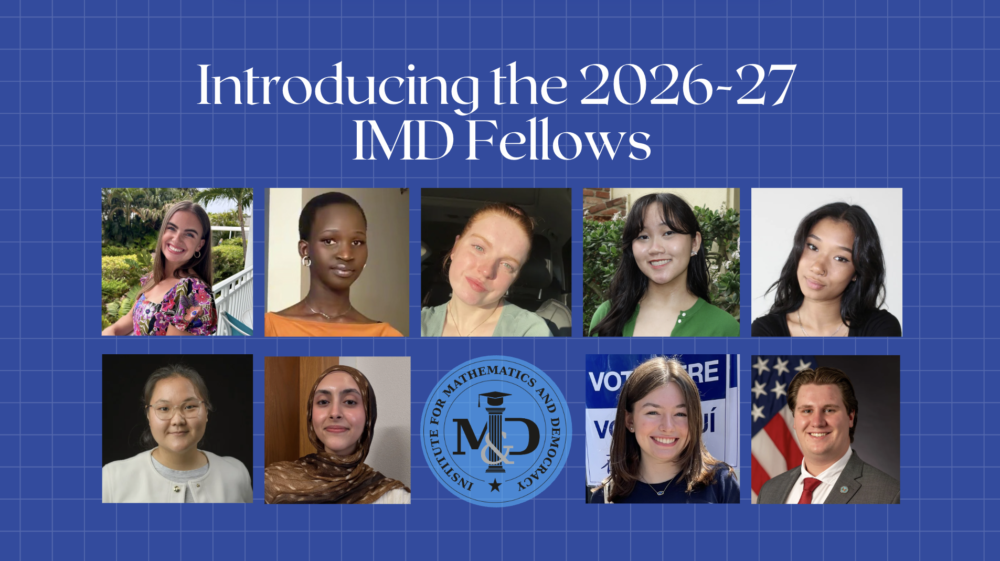
Introducing 2026-2027 IMD Fellows
This year, the IMD fellowship program has expanded to include nine undergraduate fellows from five institutions. The fellows will work with IMD faculty mentors on research at the intersection of math and democracy.
Baigali Nyamdulam and Jordyn Barger will work with Prof. David McCune (William Jewell College) to study the spoiler effect in multiwinner ranked choice elections. They will examine which proportional voting rules are most susceptible to “weak” spoiler candidates, using several different notions of weakness.
Madeline Ashton will work with Prof. Kristopher Tapp (St. Joseph’s University) on a project around computational redistricting algorithms. The mathematical core of all such algorithms involves the generation and splitting of random spanning trees. This project will explore old and new methods of generating random spanning trees, and compare their effectiveness at generating ensembles of voting maps.
Mai Li McGhee will work with Prof. Ellen Veomett (University of San Francisco) to use machine learning techniques to estimate the impact of proposed legal or policy changes on voter registration and turnout. In particular, they will look at the SAVE act and the mail-in-ballot executive order (and potentially other proposed legal or policy changes).
Brendan White will work with Prof. Jeff Wheeler (University of Pittsburgh) to further elucidate the underlying mechanism of Duncan Watts’ “model of global cascades on random networks” in a 2002 paper that determined the factors causing a narrow “cascade window” that differentiated between whether a contagion caused a “global cascade” or merely fizzled out locally in the originating subnetwork. The model relies on binary states of nodes that are flipped from zero to one by an arbitrary threshold of its neighbors being in the one state – and form a connection to case studies in social choice theory (e.g. spread of preferences, surge in candidate popularity, etc.).
At Wellesley College, Farah Rajeh and Nyamal Bangoang Riek will work with Prof. Karamatou Yacoubou Djima on a project integrating mathematical tools like Applied Harmonic Analysis (specifically shearlets) with graph-based methods and machine learning to develop affordable computational biomarkers for early autism detection. Democratic systems rely on equal opportunity and civic participation. Early detection using low-cost, low-tech placental imaging offers a universally beneficial, non-partisan approach to public health. Because placental imaging requires no expensive genetic sequencing hardware and can analyze lower-quality images taken under non-optimal conditions, it is uniquely suited for low-income and rural communities. Bridging the healthcare gap between well-funded urban centers and under-resourced regions strengthens equal access to fundamental healthcare infrastructure, which is a key pillar of a fair and inclusive democracy.
Kate Wepsic and Charlotte Chung will work with Prof. Ismar Volić on a joint project between IMD and the University of South California. The goal of the project is to understand whether topics in the intersection of math and civics are taught in K-12 schools and to what extent, and then develop instructional materials in partnership with a curriculum provider and pilot them in several schools.
IMD is grateful to all our faculty mentors for their support. We are excited about the diversity in projects and student interests with the expansion of the fellows program. Stay tuned for more research updates!