Empirical Analysis of Ranked Choice Voting Methods: Phase 2 Report Now Available
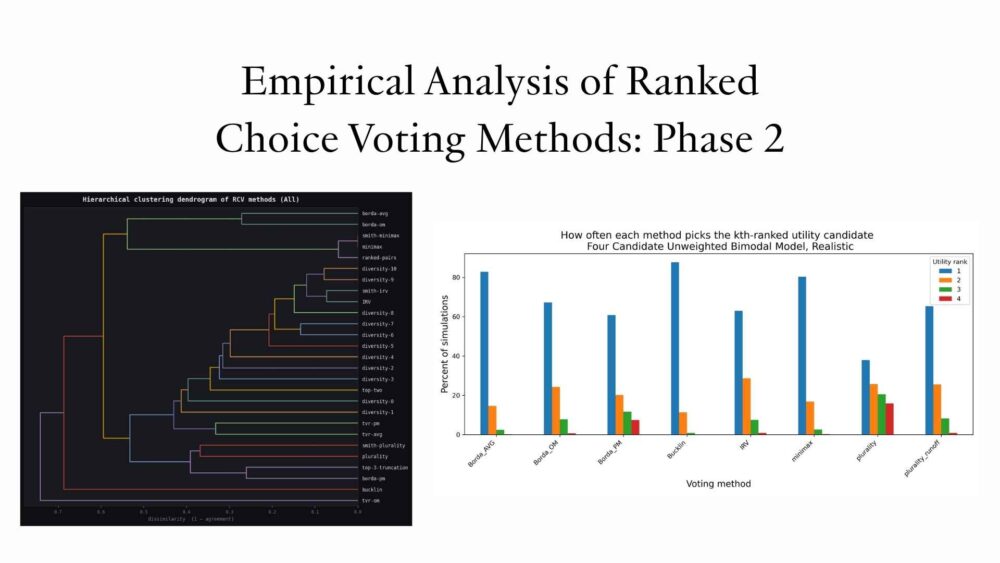
IMD research team recently completed the second phase of the empirical analysis of ranked choice voting methods. The team analyzed approximately 3,000 real ranked-choice elections and 25,000 synthetic elections generated from real ones to study strategic voting for Condorcet methods and IRV. The findings show that most Condorcet methods are vulnerable to strategically shortened ballots and artificially low rankings, while IRV has different weaknesses. Two Condorcet methods—the diversity score method with a 5% threshold and the team’s new threshold-free “friendly fire” method—show particularly strong resistance to manipulation.
The project also studied single-peakedness, social utility, and statistical fingerprinting of real elections. Although real voter preferences rarely satisfy perfect single-peakedness, many elections come surprisingly close. Condorcet methods perform well on social utility under idealized assumptions, but their advantage weakens with more realistic voter behavior. Statistical fingerprinting helps assess whether synthetic elections resemble real ones.
To read the report, access our data and visualizations, and check out our repository of datasets and code, visit the project webpage.