IMD High School Summer Research Program Project Descriptions
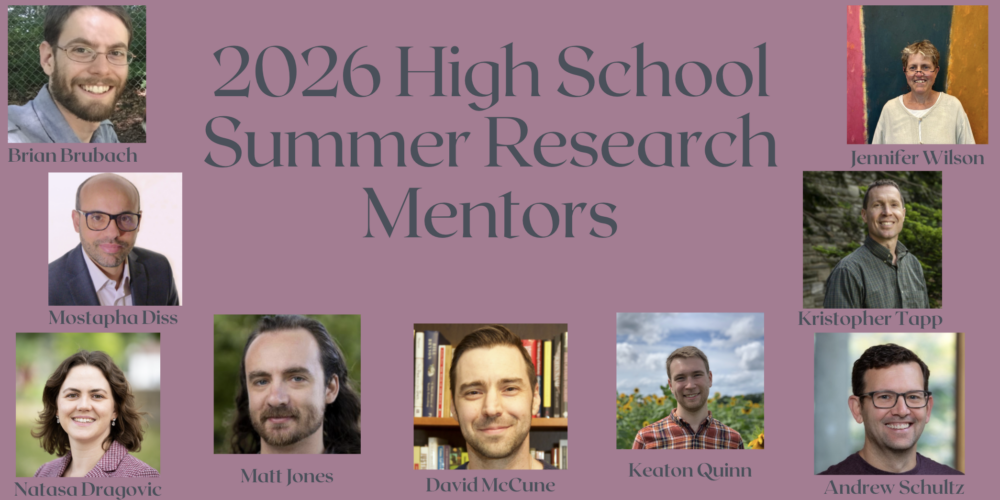
As IMD prepares for the 2026 high school summer research program, we would like to acknowledge and thank the mentors who will lead the projects. Each research group will consist of a mentor and a few students working together throughout the summer, with four of the groups including undergraduate teaching assistants.
Brian Brubach is an Assistant Professor of computer science at Wellesley College. His research focuses on algorithms and theoretical computer science with broad applications in areas such as e-commerce, fairness in automated systems, bioinformatics, and the U.S. electoral system. This is his project description:
“This project will explore measures of how close a set of ranked ballots is to being single-peaked on a line or other graph structure. We will analyze both real and synthetic election data to (1) discover characteristics of real elections, (2) identify patterns indicating electoral anomalies, and (3) check for differences between datasets using different voting rules.”
Mostapha Diss is an Affiliated Professor at Mohammed VI Polytechnic University. He is also a Full Professor of Economics at the University of Franche-Comté in France and a member of the CRESE research center since 2019. His research has focused on microeconomic theory, particularly game theory and social choice theory. This is his project description:
“The objective of this project is to analyze inequalities within the German political system using longitudinal data from the Politbarometer surveys (GESIS), which provide repeated series of public opinion data since 1977. We will develop inequality measures adapted to ordinal preferences derived from these surveys, enabling the assessment of concentration or polarization in political satisfaction rankings across socio-demographic groups, regions, and time periods. This approach will reveal the temporal dynamics of disparities in the representation of collective preferences.”
Natasa Dragovic (University of Saint Thomas) is interested in the intersection of probability and dynamical systems. Her research involves using mathematical models of opinion dynamics to make sense of political phenomena. This is her project description:
“We will explore ranked choice elections in Minneapolis and Saint Paul and look for anomalies.”
Matt Jones is an assistant professor of Mathematics at Colby College. In the area of mathematics and democracy, his research involves studying the properties of various voting methods using mathematical analysis and computation. This is his project description:
“We will be studying ballot generator models, e.g. impartial culture, Bradley-Terry, Plackett-Luce, spatial models, and compare their outputs to real ranked ballot data. Relevant questions include: What are the statistical markers of “realistic” profiles? What models most closely resemble real elections? How can we modify existing models to account for truncated ballots?”
David McCune received his PhD in geometric group theory and semigroup theory from the University of Nebraska-Lincoln in 2011. He is currently an Associate Professor of Mathematics in the Department of Mathematics and Data Science at William Jewell College. His research interests include apportionment theory and social choice theory, with an emphasis on the computational and empirical aspects of these fields. This is his project description:
“We will study spoiler effects in multiwinner elections where the spoiler candidate is particularly “weak” in some way. How often could a Pareto-dominated candidate be a spoiler for the method of single transferable vote, for example? This project is useful because the spoiler effect is seen as particularly egregious when the spoiler candidate is weak, and Pareto-dominated candidates are weak. We will explore this topic for several different notions of weak candidates, using the Scottish and Australian STV datasets as the main playground.”
Keaton Quinn (Wellesley College) is interested in the geometry of districting. His group will look into multi-winner districts and proportional representation. This is his project description:
“It is claimed that multi-winner districts increase the likelihood that the demographics of those elected more accurately represent the demographics of the voting population. We will investigate these claims using the Markov chain methods that appear in the literature. Do multimember districts always lead to proportional representation? Does it depend on the size of the POC population? Does it depend on the level, size, or location of the election? ”
Andrew Schultz is an Assistant Professor of Mathematics at Wellesley College. Previously, he was a J.L. Doob Professor of Mathematics at the University of Illinois at Urbana-Champaign. He finished his Ph.D. under the direction of Ravi Vakil at Stanford in 2007. His basic research interests are algebraic, though more specifically he’s interested in Galois module structures of ‘interesting’ objects and Hilbert 90-like results. This is his project description:
“Spatial models can be a useful way to understand how voter ideology translates into outcomes for different election types. In this project we use CES data to model elections that first run through a primary selection process before resulting in a general election. What effect does this have on the distance of the elected candidate from the median voter? How might parties act strategically to insert an independent moderate candidate to siphon of votes from their competitor? And how might incumbency or party support be factored into the model to explain persistence or favored status?”
Kristopher Tapp is a Professor in the Department of Mathematics at Saint Joseph’s University. His research areas include Riemannian Geometry, graph algorithms, and combinatorics. His recent work focuses on applying mathematics to redistricting and election analysis. This is his project description:
“We will study the distribution of ballot lengths in Scottish and other ranked choice elections. How does it depend on the number of candidates and seats? On the number of candidates in one’s preferred party? On the clustering of a profile into blocs of voters? How frequently is it the case that blocs of voters could have obtained a more desirable outcome by extending or shortening their ballots? With respect to which social choice mechanism (STV, Borda, etc) is the outcome most affected by the ballot length distribution?”
Jennifer Wilson is an Associate Professor of Mathematics at The New School. Her research interests include voting and social choice theory, systems of political representation, resource allocation and cooperative game theory. She has also developed courses in Gerrymandering and Fair Representation, and Fair Division and Politics. This is her project description:
“We will work on one of two projects depending on student background and preferences. The first is to look at the behavior of mult-winner voting methods for a small number of candidates on single-crossing domains. The second is to compare the results by party of the Scottish elections and the results of using a standard apportionment method.”
The undergraduate teaching assistants for this year’s program are Valerie Zhu, Elaine Zhao, Gahan Sabbir, and Erik Hill.
Thank you to all of the mentors and teaching assistants for their integral roles in the program. We look forward to seeing the work their teams will do this summer. Stay tuned for more research updates!