IMD Team Releases Paper Titled “Candidate Moderation Under Instant Runoff and Condorcet Voting: Evidence from the Cooperative Election Survey”
The first paper has been released following the completion of a project conducted by a team of IMD researchers who analyzed approximately 4,000 real-world ranked ballot elections, including some 2,000 political elections from the U.S., Australia, and Scotland. The analysis, believed to be the largest study of such elections ever performed, is supplemented by the investigation of millions of synthetic elections generated from survey data in the Cooperative Election Study, creating a robust simulation-based complement to the real-world data.
See the abstract and link to the publication below:
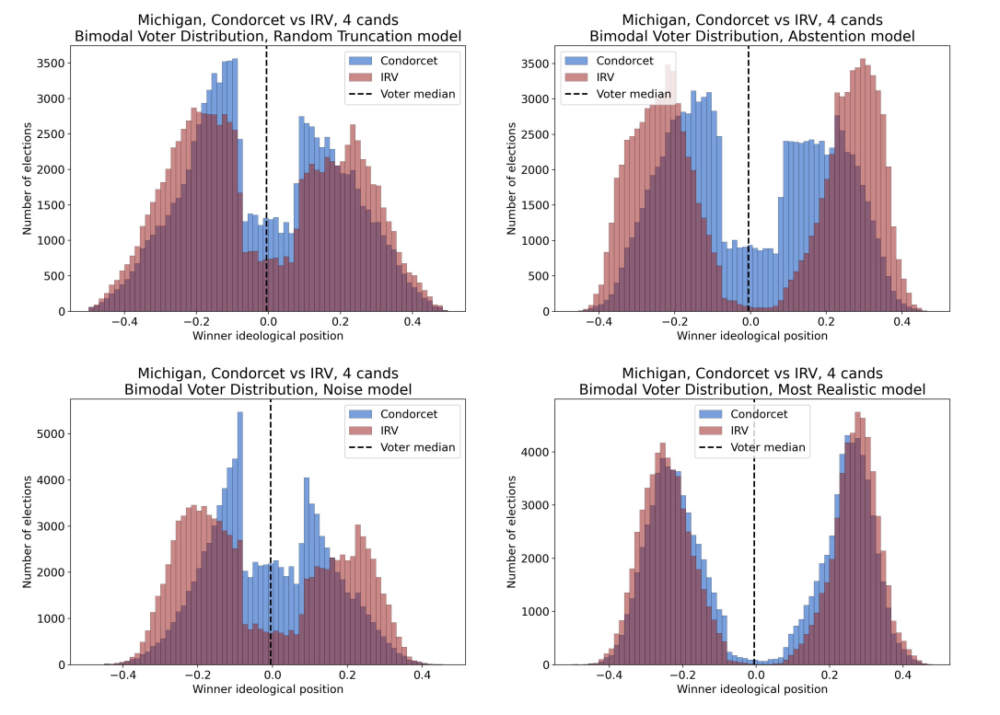
“This article extends the analysis of Atkinson, Foley, and Ganz in “Beyond the Spoiler Effect: Can Ranked-Choice Voting Solve the Problem of Political Polarization?”. Their work uses a one-dimensional spatial model based on survey data from the Cooperative Election Survey (CES) to examine how instant-runoff voting (IRV) and Condorcet methods promote candidate moderation. Their model assumes an idealized electoral environment in which all voters possess complete information regarding candidates’ ideological positions, all voters provide complete preference rankings, etc. Under these assumptions, their results indicate that Condorcet methods tend to yield winners who are substantially more moderate than those produced by IRV. We construct new models based on CES data which take into account more realistic voter behavior,
such as the presence of partial ballots. Our general finding is that under more realistic models the differences between Condorcet methods and IRV largely disappear, implying that in real-world settings the moderating effect of Condorcet methods may not be nearly as strong as what is suggested by more theoretical models.”