
New Report and Interactive Website: Empirical Analysis of Ranked Choice Voting Methods
IMD is excited to announce that our study of Ranked Choice Voting is now complete. In 2024-25, a team of IMD researchers analyzed approximately 4,000 real-world ranked ballot elections, including some 2,000 political elections from the U.S., Australia, and Scotland Our analysis, believed to be the largest study of such elections ever performed, is supplemented by the investigation of millions of synthetic elections generated from survey data in the Cooperative Election Study, creating a robust simulation-based complement to the real-world data.
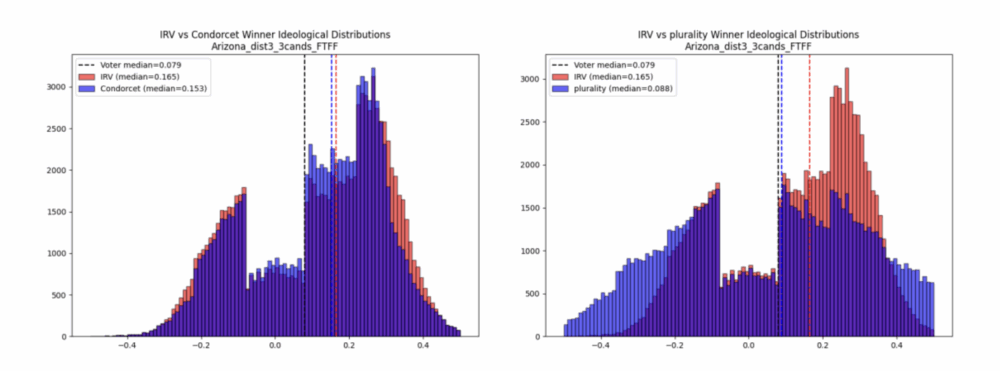
The general finding is that the best performing ranked choice voting methods are instant runoff voting (IRV) and Condorcet methods. These kinds of methods are the least likely to be susceptible to various kinds of spoiler effects, are mostly resistant to undesirable forms of strategic voting, and are unlikely to elect “weak” or “fringe” candidates. Though IRV and Condorcet methods can elect different candidates, we found that they agree an overwhelming amount of the time in the real-world elections we sampled. From this point of view, whether IRV or a Condorcet method is used will make little practical difference. However, while it could appear from our synthetic generated elections that Condorcet is slightly “better” than IRV, we believe that IRV has some logistical and pragmatic advantages over Condorcet.
To read the report, access our data and visualizations, and check out our repository of datasets and code, visit the project webpage.