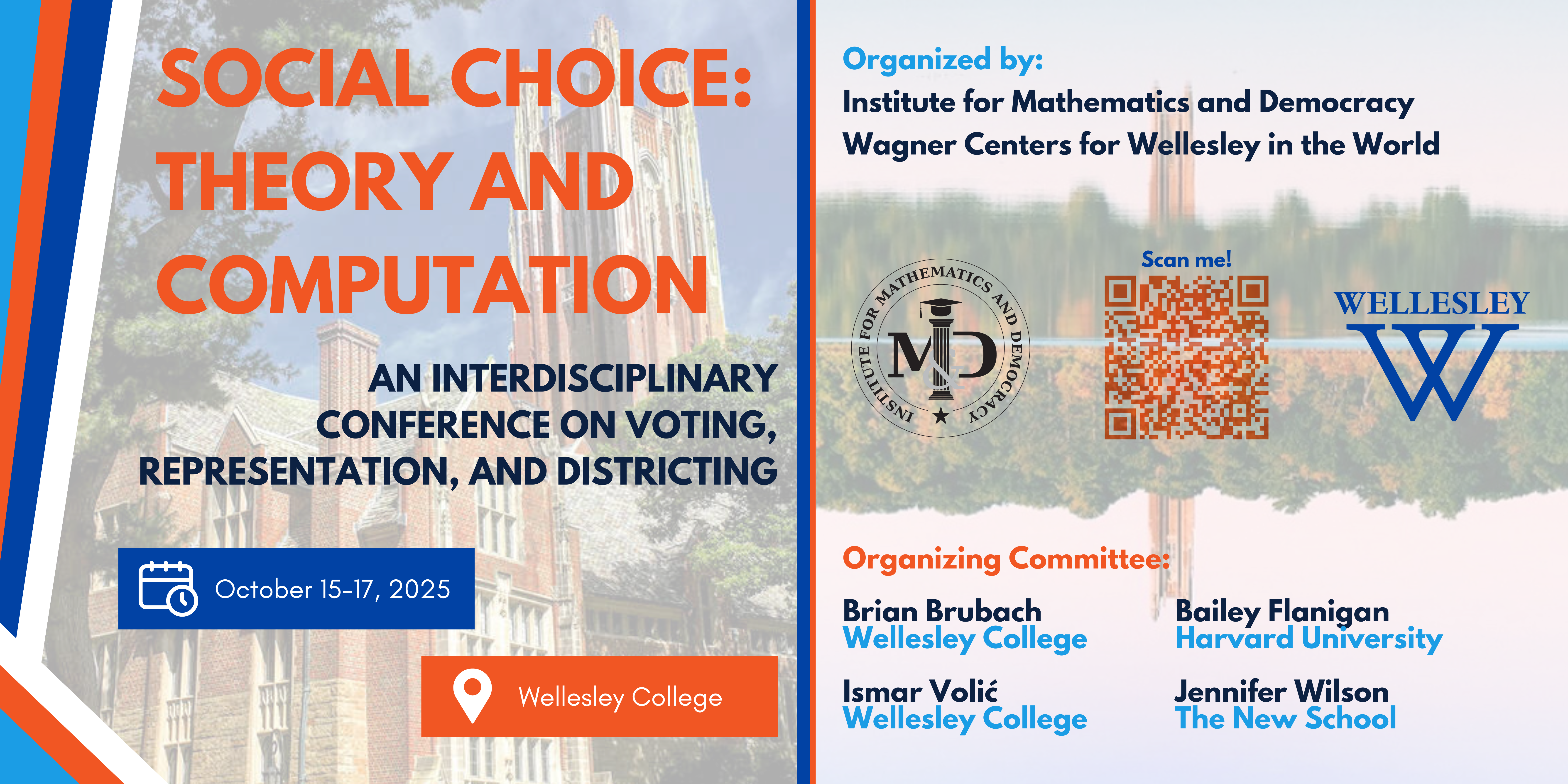
Institute for Mathematics and Democracy, in collaboration with Wellesley College Wagner Centers, is organizing
Social Choice: Theory and Computation
An Interdisciplinary Conference on Voting, Representation, and Districting
October 15-17, 2025
Wellesley College
Please check this page for updates, including hotel information and the registration form.
For questions, please email contact@math-democracy.org.
Speakers











Logistics
The registration for the conference consists of two steps:
1. Fill out this registration form.
If you would like to be considered for financial assistance to attend the conference or if you are a student or a post-doc who wants to contribute a poster, the deadline to fill out the form is August 1, 2025. The organizing committee will let you know whether your poster has been accepted to the conference by September 1. Priority will be given to graduate students.
Otherwise the deadline is September 10, 2025.
2. Pay the registration fee by visiting this page.
After filling out the required fileds and adding the registration fee to your cart, select “shopping cart” at the top of the page to check out.
If you are affiliated with Wellesley College, you do not need to pay the registration fee.
A block of rooms has been reserved at The Verve Hotel, 1360 Worcester St, Natick, MA 01760.
The conference rate is $179 plus applicable taxes and fees.
To make a reservation, please visit this page. You may also call 1-800-Hiltons and reference group code 937 or use the Hilton Honors App and input group code 937.
The hotel is not walking distance to campus, but shuttle transport will be provided.
Alternatively, participants can choose to book a room on their own, including in Boston. There is train service from Boston to Wellesley which takes about 35 minutes; the campus is another 10-minute walk from the train station.
Here is a map of the Wellesley College campus. If you are driving to the conference, parking is free in the Davis Parking Facility (adjacent to the campus police station; you may have to zoom in on the map to see it).
Wednesday evening event and dinner will take place at the Tishman Commons, located on the ground floor of the Lulu Chow Wang Campus Center.
The rest of the conference on Thursday and Friday will take place at the Science Center. More details can be found in this document.
To see the abstract for a talk, please click on the talk title.
- Rob Richie (Expand Democracy)
- Ariel Procaccia (Harvard University)
- Alma Steingart (Columbia University)
Moderated by Ismar Volić (Wellesley)
8:30 – 9:00
Coffee and registration
How should one design unprecedented democratic processes capable of handling enormous sets of alternatives like all possible policies, bills, or statements? I argue that this challenge can be addressed through a framework called generative social choice, which fuses the rigor of social choice theory with the flexibility and power of large language models. I then explore an application of generative social choice to the problem of identifying a proportionally representative slate of opinion statements. This includes a discussion of desired properties, an algorithm that provably achieves them, an implementation using GPT, and insights from an end-to-end pilot. By providing guarantees, generative social choice could alleviate concerns about AI-driven democratic innovation and help unlock its potential.
10:00 – 10:15
Coffee break
11:15 – 11:30
Coffee break
12:30 – 2:30
Lunch and poster session
How can you tell if a political districting plan is gerrymandered? This is a hard question: compactness of districts or proportionality of election outcomes don’t tell the whole story. One method is too look at where a districting plan falls within the space of all possible districting plans – if it’s an outlier, it might be gerrymandered. However, there are far too many possible districting plans to look at all of them. Instead, we use random sampling algorithms: by picking a random subset of possible districting plans, we can still get a good idea of what this space of all possible districting plans looks like. How do we generate random political districting plans, and how do we know these plans are “random enough” for our purposes? This talk will provide an introduction to this area of work, including what’s been done, some recent results, and what we still don’t know, as well as some cautions about the limitations of this method.
3:30 – 4:00
Coffee break
We exhibit a voting method that is resistant to strategic voting and elects the majority (also called the Condorcet winner) winner when voters’ preferences over candidates are single-peaked (i.e., a voter prefers candidates closer to her along the ideological spectrum to those farther away). Moreover, we show that this system is (essentially) the unique strategy-resistant system among all voting methods satisfying anonymity (equal treatment of voters) and neutrality (equal treatment of candidates) for such preferences.
Preferences in actual political elections do not usually adhere strictly to single-peakedness. Nevertheless, we present evidence that every state and federal ranked-choice election in Maine and Alaska held to date satisfies a weak form of single-peakedness sufficient to guarantee our voting method is strategy-resistant.
Aggregation takes place when multiple inputs (ballots cast by voters, for example) are combined to yield a decision (the election winner). A zoo of known aggregation procedures, such as
(1) Plurality voting,
(2) Approval voting,
(3) Kemeny voting,
(4) Borda voting,
(5) Mirkin aggregation of equivalence relations (a form of cluster analysis),
(6) The Mean Rule (Duddy and Piggins),
(7) j,k-Kemeny (a version of Kemeny for weak orders), or
(8) Any of the known Condorcet extensions: Copeland, minimax, etc.
vary widely in their allowed inputs, allowed outputs, and mechanisms used to process inputs into outputs, obscuring the similarities and differences among them. But many (not all) of the listed procedures arise as special cases of the median procedure MP (Barthélemy and Monjardet, 1981), a highly general rule for aggregating binary relations of some type into a single relation. Seen in this light, these procedures all aggregate information in exactly the same way, but differ with regard to which dimensions of information are taken into account. While MP is usually defined via a metric (choose the outcome closest to the inputs) an alternate formulation via inner (aka, “dot”) product and orthogonal decomposition is better equipped for this analysis, explaining (for example) how and why computational complexity varies among the procedures.
In this talk we survey the results of the analysis of a large collection of elections with ranked ballots from across the United States, Australia, Scotland, as well as the Condorcet Internet Voting Service (CIVS) database. We compare and contrast various electoral methods such as ranked-choice voting, Condorcet-consistent methods, plurality and approval-based methods. This allows us to answer questions about whether disingenuous voting and/or nominating is naturally incentivised, whether there exists a ‘spoiler’ candidate, and so on. We focus in particular on analyzing instant runoff, Condorcet and plurality.
The deadline for submitting a poster has passed. If you have been selected to present a poster, you can find more details about the process in this document.
Organizing Committee